Lab-grown diamond guidance · 02
The 4Cs of Diamonds
The 4Cs are a useful shared language. They help you compare diamonds, but they work best when considered together rather than treated as four separate scores.
Laura Luxe education · 3 min read
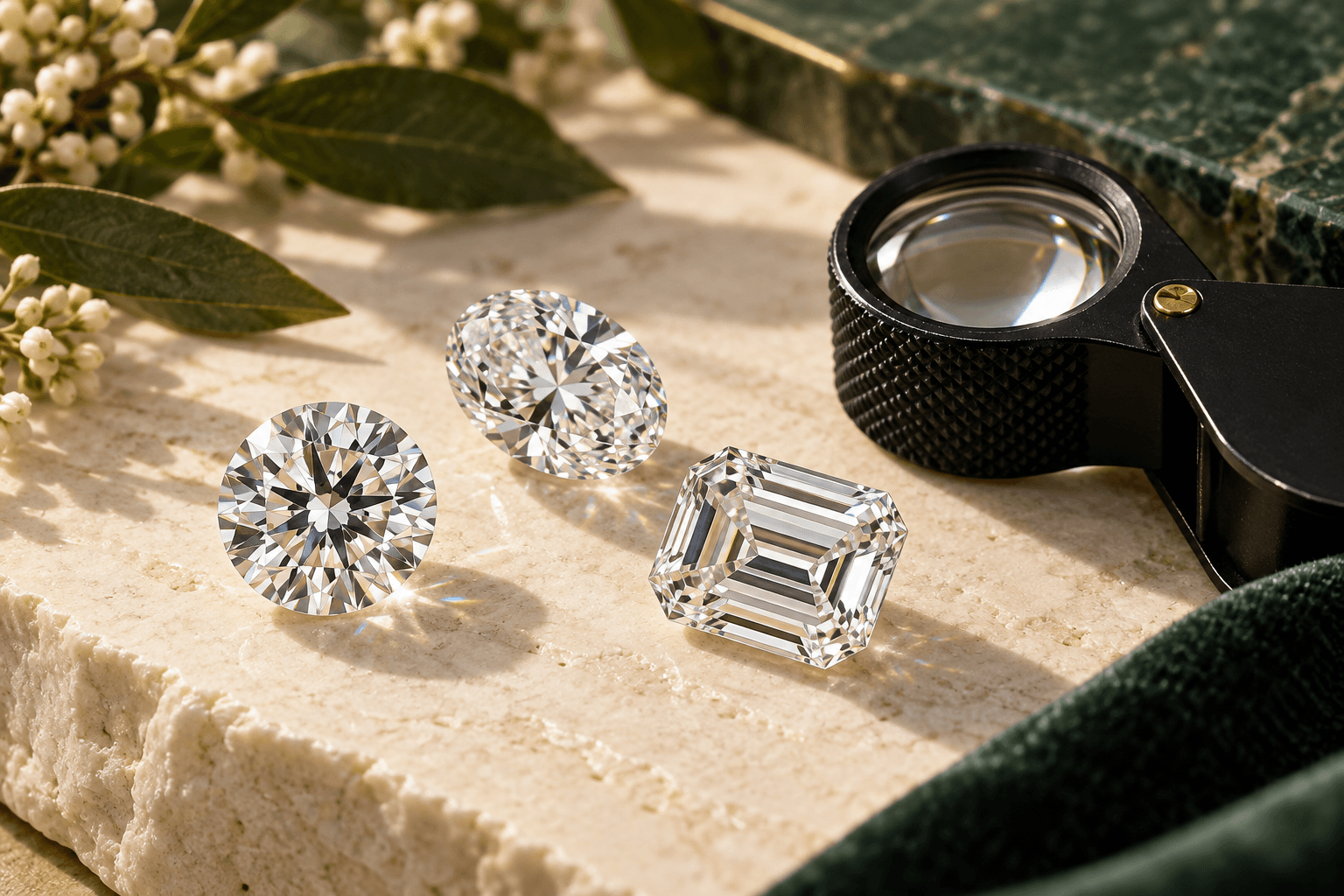
Cut
Cut describes how successfully a diamond’s proportions, symmetry, and polish return light. It is often the most important factor in visible sparkle.
Colour
Colour grades describe how much body colour a diamond shows. Some designs suit a bright, icy look; others are beautiful with a warmer character.
Clarity
Clarity describes natural internal features and surface marks. Many inclusions are difficult to see without magnification, so prioritise what is visible to the eye.
Carat
Carat is a unit of weight. Two diamonds with the same carat can look different in size because shape, depth, and proportions affect their face-up appearance.
Cut: look beyond the outline
Cut quality concerns how facets and proportions work together. Brilliance is white light returned to the viewer, fire is the separation of light into colours, and scintillation is the changing pattern of bright and dark areas as the diamond moves.
Do not assume every shape or report uses the same overall cut grading system. For fancy shapes, moving images and the individual facet pattern are especially useful. Polish and symmetry describe specific finishing characteristics; they do not, by themselves, guarantee exceptional light performance.
Colour: compare in consistent conditions
Where a report uses the familiar D–Z scale for colourless to light-colour diamonds, D is at the colourless end. This is different from grading fancy-colour diamonds. Read the actual laboratory terminology rather than translating unfamiliar labels yourself.
Compare stones under the same neutral lighting and against the same background. Metal colour and surrounding reflections can influence how a diamond looks once set. A face-up comparison is useful because that is how you will usually see your ring.
Clarity: position matters as well as grade
Clarity describes internal inclusions and surface blemishes. On reports using the traditional scale, categories range from Flawless and Internally Flawless through VVS, VS, SI and Included. These labels reflect examination conditions, not simply what you can see while wearing the ring.
A dark inclusion under the centre may be more noticeable than a pale feature near an edge. Step cuts can reveal features differently from brilliant cuts. Ask whether any feature affects durability, especially near a thin edge or a point that will be set under a claw.
Carat: weight versus visible size
One carat is 0.2 grams and is divided into 100 points. A 0.75-carat stone is therefore 75 points. Carat does not specify its diameter or length: two stones of the same weight can distribute that weight differently.
Compare the report’s measurements alongside a size reference. In a ring with several diamonds, total carat weight is the combined weight of those stones; it must not be mistaken for the centre stone’s weight. Ask for both figures when the design includes accents.
Use the four measures together
Make a shortlist with the outline and dimensions you like, then inspect light performance and visible colour or inclusions. Only after that should you decide whether a higher reported grade offers a difference you personally value.
Keep comparison conditions consistent. A diamond under strong spotlights can look dramatically different from the same stone beside a window. Ordinary lighting helps you understand the appearance you will live with day to day.
At a glance
| Measure | What it describes | A useful question |
|---|---|---|
| Cut | Faceting, proportions and finishing | How does it return light as it moves? |
| Colour | The body colour described by the report | How does it look in my chosen metal? |
| Clarity | Internal inclusions and surface blemishes | Can I see the features at normal viewing distance? |
| Carat | Weight; one carat equals 0.2 grams | What are its face-up measurements? |
Your checklist
- Read the report’s exact grading terminology.
- Compare videos in consistent lighting.
- Check inclusion position as well as the clarity label.
- Separate centre weight from total carat weight.
- Use millimetres to compare visible size.
Common questions
Which C should I prioritise?
Light performance is a useful starting point, then balance size and visible colour or inclusions according to your preferences. There is no universal grade combination for everyone.
Does eye-clean mean flawless?
No. Eye-clean is an informal description of visibility under particular viewing conditions. Flawless is a specific laboratory clarity grade.
Can I compare grades across different laboratories directly?
Check the grading system and report type first. Different terminology or assessment practices can make a simple label-to-label comparison misleading.
Continue exploring
Make the details personal.
Share your references, questions and preferred budget with Laura Luxe for advice about your piece.
Contact Laura Luxe