Engagement ring guidance · 02
Engagement Ring Design Basics
Every ring is a conversation between its centre stone, setting, band, and the hand it is made for. These are the basics that shape the final result.
Laura Luxe education · 3 min read
The centre stone
Shape determines the outline; cut determines how light moves through the stone; carat influences scale. Colour and clarity help refine the look and the value.
The setting
The setting holds the stone securely and gives the ring its character. Consider visibility, protection, cleaning, and how high or low the stone should sit.
The band
Width, profile, finish, and metal colour all change how a ring feels. A slightly rounded interior can make a band especially comfortable for daily wear.
The details
Hidden accents, a delicate halo, a tapered shoulder, or a thoughtful engraving can make a classic design feel uniquely personal.
Learn the anatomy of a ring
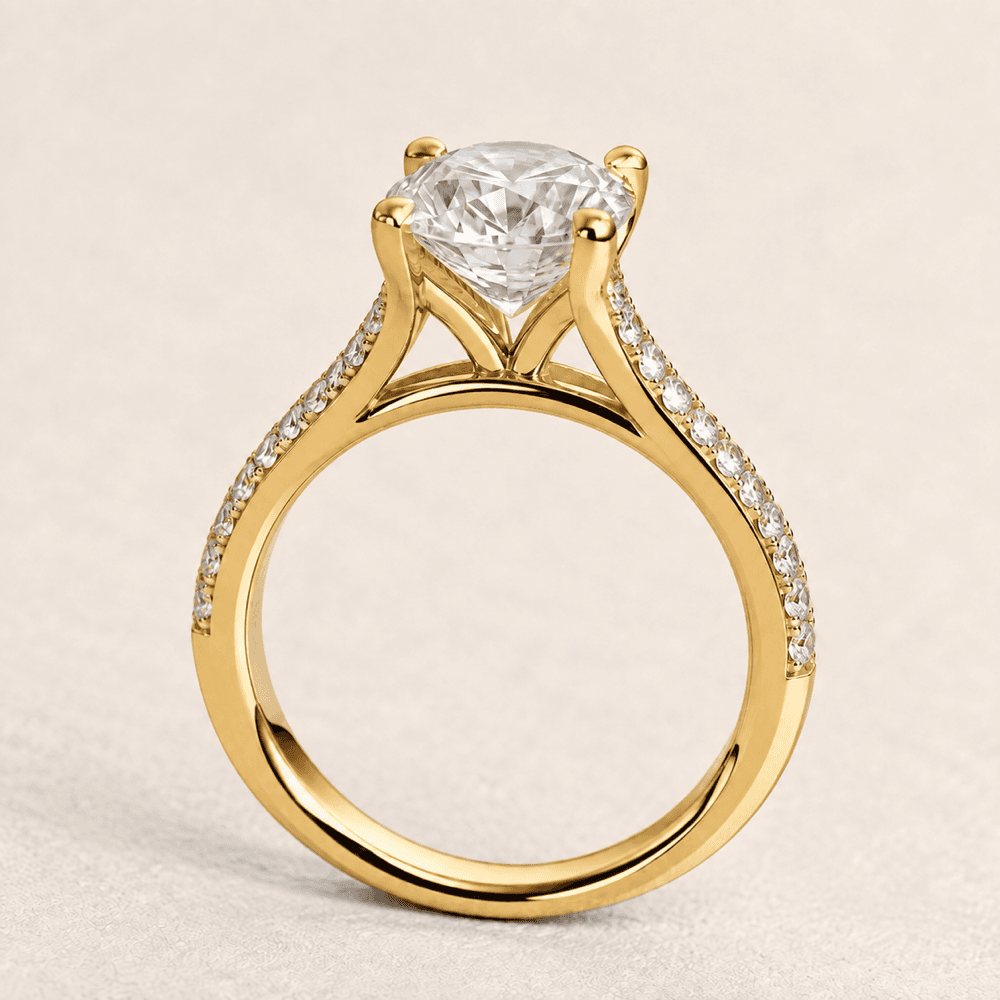
The shank is the band around your finger. Its shoulders are the parts rising towards the centre stone. The head or basket supports the stone, while prongs or a bezel hold it in place. A gallery is the structure visible beneath the centre stone when viewed from the side.
These terms help turn a vague request into a useful design note. Asking for lower shoulders, a more open gallery or rounded claws gives the jeweller a clearer starting point than asking for a ring to feel softer.
Setting styles and their trade-offs
A prong setting leaves much of the diamond visible but should have smooth, secure claws. A bezel surrounds the edge with metal and gives a continuous outline; its proportions determine how much of the diamond’s perimeter is visible. A halo adds small stones around the centre and changes the overall footprint.
Cathedral describes shoulders that rise towards the head; it is not a separate method of securing the diamond. A cathedral ring may still use prongs or a bezel. Pavé describes small stones set along a surface, often the band, and adds more areas that need careful cleaning and inspection.
- Solitaire: one centre stone is the visual focus.
- Three-stone: compare side-stone scale and finger coverage.
- Halo: assess the full outline, not only the centre stone.
- Toi et moi: check how both stones sit against neighbouring fingers.
Width, thickness and height are different measurements
Band width is what you see looking down at the ring. Thickness is the depth of metal between the finger and the outer surface. A band can appear broad yet be shallow, or look narrow while retaining more depth. Both dimensions influence feel and durability.
Setting height is measured in a different direction again: how far the centre assembly rises from the finger. Ask for all three dimensions when comparing designs online. Tiny differences may be hard to read in a magnified image.
Details should work together
A hidden halo sits beneath the centre stone and is most visible from the side. Milgrain adds a beaded edge, and engraving creates line and texture in the metal. These features change the character without necessarily changing the stone.
Decide where you want the eye to rest. If the centre diamond is the focus, quieter shoulders can support it. If the band is expressive, a simpler head can keep the ring readable. Leave room for cleaning access and future maintenance when choosing decoration.
At a glance
| Setting | Visual character | What to check |
|---|---|---|
| Prong | An open view of the centre stone | Claw security, smooth tips and protection of corners |
| Bezel | A continuous metal border | Rim proportions and cleaning access |
| Halo | Small diamonds frame the centre | Overall footprint and maintenance of accent stones |
| Cathedral shoulders | Arches rise towards the head | Side profile, height and wedding-band clearance |
Your checklist
- Identify the shank, shoulders, head and gallery.
- Ask for band width, thickness and setting height.
- Check the side profile with a wedding band.
- Confirm how decorative details affect resizing and care.
Common questions
Are shape and cut the same thing?
Shape describes the outline, such as oval or pear. Cut can refer to faceting style and, in grading, the quality of proportions and light performance.
Does a taller setting make a diamond sparkle more?
Height alone does not determine sparkle. The stone’s cutting and the complete setting design matter; choose height primarily for appearance, clearance and wearability.
Continue exploring
Make the details personal.
Share your references, questions and preferred budget with Laura Luxe for advice about your piece.
Contact Laura Luxe